
What’s one thing you own that holds deep sentimental value?
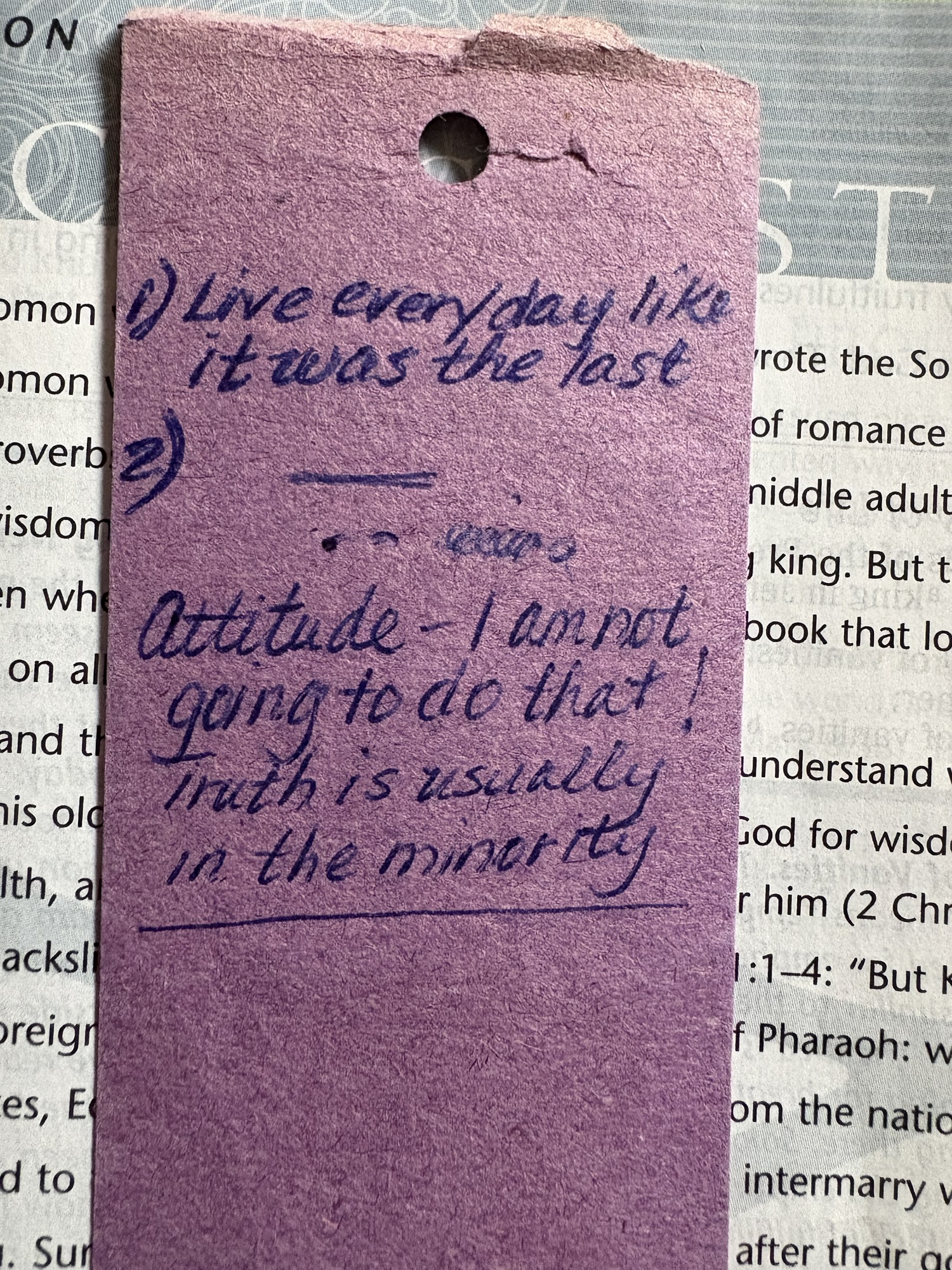
My late father’s Bible. His favorite book, filled with sentimental bookmarks and his handwritten notes, has become my favorite book, too.
Funny… how life is. There was a time when a Bible seemed like the last thing I wanted to read. But now, my father’s written insights are enlightening. I am following his path.

In reference to heaven, he wrote:
“What we will be doing, what we will look like, what our homes will look like, we do not know exactly. The Bible does not detail.”
Another interesting fact is that my father specifically wrote notes in reference to women in his Bible.

“Her marriage, behavior, character, family life, and spiritual life.”

He also wrote, “We offer tribute and seek to honor her.”

Right there is where he placed a bookmark I gave him when I was five years old. On the back of that bookmark, he wrote:
“Live every day like it was the last.”
And:
“Attitude – I am not doing that! Truth is usually in the minority.”
- ●
These last two weeks, I’ve felt like I’m part of the minority. It’s been a struggle of sorts. The question of what is mine to do keeps surfacing.
Last week, I received a medical and forensic report from a local domestic violence and sexual assault center. The document contains clinical documentation and my account, recorded during an examination following an experience that profoundly affected me.
I didn’t believe I had access to these records until recently.
Reading the 40-page file brought me back to a period of my life that I have spent considerable time trying to understand. For a long time, I’ve second-guessed myself, my experiences, and even my recollections.
Sometimes, having something documented doesn’t change what happened. It changes how we understand what happened.
For me, reading those records was a reminder that my experiences deserve to be taken seriously, including by me.
It also brought up some difficult questions.
What do we do when our experiences don’t align with someone else’s version of events?
How do we reconcile what we remember with what others tell us happened?
How much energy should we spend trying to convince someone else of something we have struggled to understand ourselves?
And perhaps most importantly, when is it time to start trusting our own ability to move forward?
●
I’ve been considering what moving forward is and what accountability, healing, and justice actually mean.
I don’t know where those conversations will lead.
I do know that asking questions is worthwhile. Seeking information is worthwhile. And acknowledging difficult experiences, even when doing so is uncomfortable, is worthwhile.
There are things in life we cannot go back and change. There are also things we don’t have to continue carrying.
I’m learning to distinguish between the two.
My Mom worries about my safety. I understand why. There are experiences in my past that have given her reason for concern, and I take those concerns seriously.
Still, I want to live.
Not simply exist, manage circumstances, or spend my days anticipating what might happen next.
I want to create, write, paint, laugh, explore, and experience the world beyond the difficult chapters I’ve already lived.
I want to live every day as if it were my last.
●
Perhaps that’s what my father’s words mean to me now.
Truth isn’t always popular. It isn’t always understood. Sometimes it takes years, documentation, distance, and a little courage to recognize it for ourselves.
And perhaps the question isn’t whether everyone will agree with our version of the story.
Perhaps the question is whether we’re willing to keep writing it.
●
Birdanity


Leave a Reply