
What’s one thing you own that holds deep sentimental value?
My late father’s Bible. His favorite book, filled with sentimental bookmarks and handwritten notes, has become my favorite book, too.
Funny how life is. There was a time when a Bible seemed like the last thing I wanted to read. But now, my father’s written insights are encouraging. I find myself following in his footsteps.
Sorta.
Maybe in a backwards moonwalk kind of way.
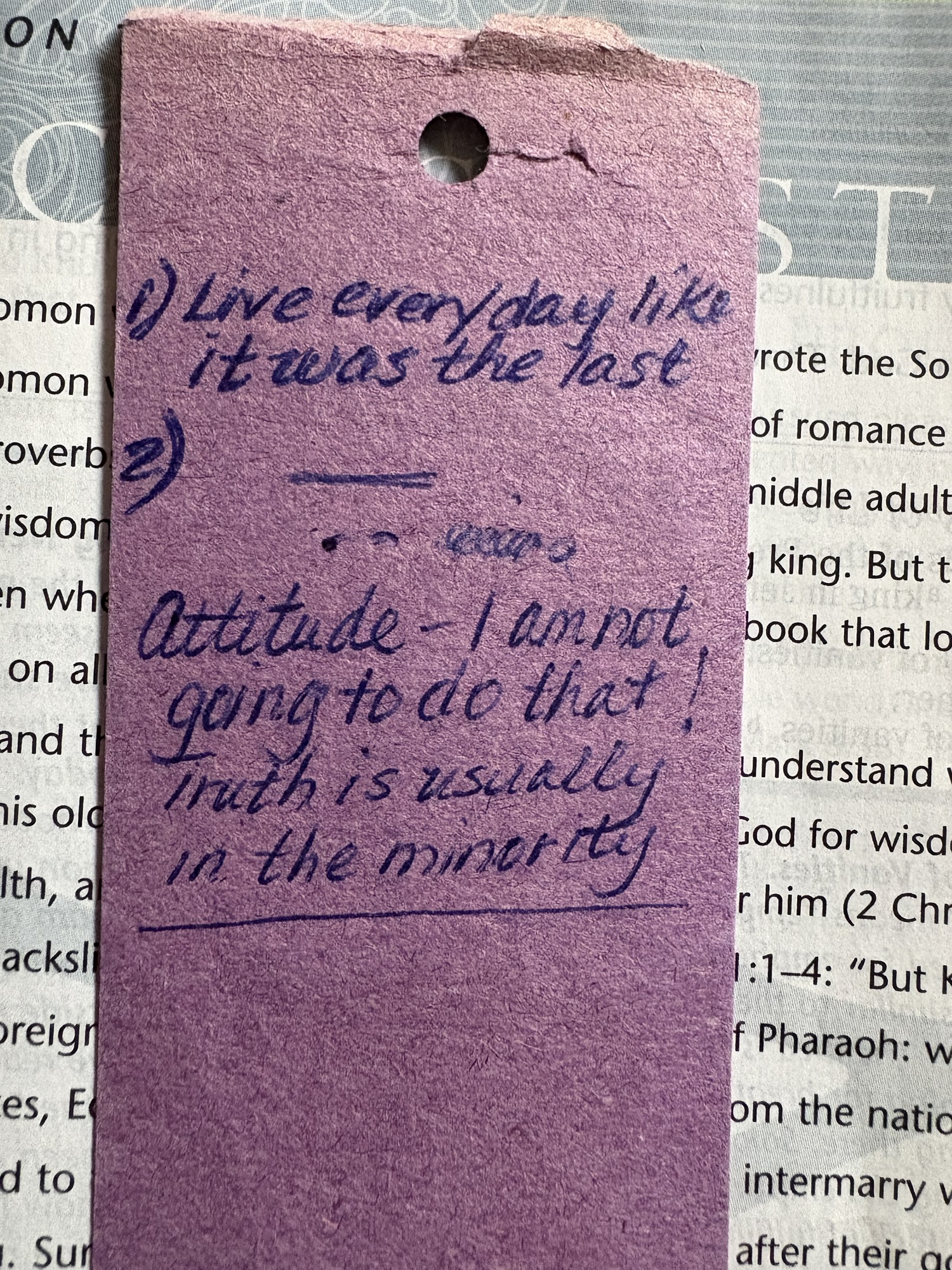
In a passage where he had written several thoughts about women, he also placed a bookmark I gave him when I was five years old. On the back of that bookmark, he wrote:
“Live every day like it was the last.
Attitude – I am not doing that! Truth is in the minority.”
●
I gave my father that bookmark when I was five. I doubt I understood the significance of the words I was giving him, or that one day I’d be reading his handwriting and discovering how much of my own philosophy had come to resemble his.
Perhaps that’s one of the unexpected gifts of getting older. We begin to understand our parents in ways we couldn’t when they were here. Sometimes, we even find ourselves continuing conversations they started decades ago.
I’ve often wondered what my father meant by truth being in the minority. Was he talking about the unpopular opinion? The uncomfortable observation? The things people recognize privately but aren’t willing to acknowledge publicly?
As a writer, I find myself returning to that thought.
●
Lately, I’ve been struggling with questions about what is true for me. The question of what is mine to do keeps surfacing, too. I think an awful lot about what my Dad would think or do. Sometimes, I even wonder what he would say if he were here to protect me.
I wonder what advice he might offer about the medical and forensic records I recently received concerning a domestic violence incident involving a former partner. Would he even want to read them? I imagine we’d both shed a few tears if we did.
The file contains clinical documentation and my word-for-word account of an event that profoundly affected my life. Some of the documentation dates back to the time of the incident, giving me an opportunity to revisit an experience through medical and forensic records I hadn’t previously had in my possession.
I’m also taking a healthy relationships class alongside other women whose lives have been affected by domestic violence. It often serves as a weekly reminder of my own experiences.
Reading the 40-page file brought me back to a period of my life that I’ve spent considerable time trying to understand. The violence I endured. Why I stayed in an abusive relationship for as long as I did. The things I questioned, minimized, or struggled to make sense of.
For a long time, I’ve second-guessed myself, my experiences, and even my recollections.
Sometimes, having something documented doesn’t change what happened. It changes how we understand what happened.
For me, reading those records was a reminder that my experiences deserve to be taken seriously, including by me.
It also brought up some difficult questions.
What do we do when our experiences don’t align with someone else’s version of events?
How do we reconcile what we remember with what others tell us happened?
How much energy should we spend trying to convince someone else of something we’ve struggled to understand ourselves?
And perhaps most importantly, when do we stop looking for permission to trust our own recollections and begin moving forward?
●
I’ve been considering what moving forward actually means, and what accountability, healing, and justice look like.
I don’t know where those conversations will lead.
I do know that asking questions is worthwhile. Seeking information is worthwhile. And acknowledging difficult experiences, even when doing so is uncomfortable, is worthwhile.
There are things in life we cannot go back and change. There are also things we don’t have to continue carrying.
I’m learning to distinguish between the two.
As a writer, I also recognize that writing honestly means accepting that not everyone will agree with what we have to say. Sometimes the most meaningful things we write are the ones that challenge our own assumptions, too.
I don’t want to write simply to be understood or agreed with. I want to write to examine, question, and make sense of the world as I experience it.
•
Family and friends say they are concerned about my safety. They also support my writing.
In this writing thing I do, I want to live as though I am truly free.
Not simply exist, manage circumstances, or spend my days anticipating what might happen next.
I want to create, write, paint, laugh, explore, and experience the world beyond the chapters I’ve already lived.
I want to live every day as if it were my last.
●
Maybe these two thoughts from my father are more connected than I initially realized.
Live every day like it was the last.
Truth is in the minority.
Perhaps living honestly means accepting that we won’t always be understood. Perhaps it means having the courage to examine our experiences, acknowledge what we discover, and keep moving even when the answers aren’t particularly comfortable.
I don’t want to spend whatever time I have left trying to make my experiences acceptable to everyone else.
I want to write about life. The beautiful parts, the ridiculous parts, the uncomfortable parts, and the things I’m still figuring out.
I want to leave something behind that reflects how I actually lived, thought, questioned, and experienced the world.
My father’s Bible is a record of his thoughts, observations, and life. In my own way, perhaps Birdanity is becoming a record of mine.
We are allowed to write about healing without turning every paragraph into a defense of our credibility.
We are allowed to acknowledge what happened without making our entire lives about what happened.
Perhaps that’s what my father was reminding himself of when he wrote those words. Maybe truth doesn’t need a majority to be worth writing about.
And perhaps that’s what I’m learning to do now. Write.
Right.
•
I don’t know if I’m following in Dad’s footsteps.
Maybe I’m simply continuing the conversation between us.
Moonwalk style.
●
Signed,
Stephanie Bird


Leave a Reply